

A Burning Fascination
After nearly 50 astonishing years, Todd Hoeksema '74 just keeps looking up.
Please know, dear reader, this story is not intended to call your work into question. You are doing great and wonderful things and our world is infinitely better with your contributions. Please keep going, keep grinding, keep doing your thing.
But. And be honest here, by a show of hands, how many of you have you busted out the tools of helioseismology to assess the inside of the sun? Who amongst us has utilized a refracting telescope, CCD camera, and rotating interferometers to measure space velocity and magnetic fields on the solar photosphere?
(Please note: The above tongue-in-cheekiness may not apply to any astrologers, NASA scientists, or select engineers reading this story. It certainly does not apply to Todd Hoeksema ’74.)
***
Todd Hoeksema is a renowned solar physicist. And after learning about his forty world-changing years on the job – the adjective ‘world-changing’ is not an embellishment – I have reached the following conclusion.
His work is really, really cool.
“I have always loved astronomy and found that studying the Sun had the added benefit of being practical,” says Hoeksema, Professor of Physics at Stanford University and Director of the COFFIES DRIVE Science Center. “Our star affects the Earth and human technology in ever increasing ways. Being prepared for hazardous solar storms helps keep astronauts and satellites safe and prevents technological problems on the ground.”
To understand Hoeksema’s burning fascination to study our galaxy’s greatest star, it is important to also understand his affinity for Stanford, and the university’s role as catalyst in supporting his scientific curiosity and affording opportunities to further his life’s work.
“I have spent most of my career at Stanford because it almost always felt like the most interesting place to be for the next few years,” he says.
Following his graduation from Prairie in 1974, Hoeksema attended Calvin College in Michigan where he majored in Physics (with honors) and Mathematics, graduating in 1978. From there, Stanford, and for the most part – except when NASA came calling (which we will get to in a moment) – he has never left.
Prior to arriving on campus for his graduate studies, an unexpected phone call from Stanford proved kismet. The university’s researchers needed summer help at the school’s solar observatory. They presented Hoeksema with the possibility of a summer job, an offer sweetened by the inclusion of an apartment with a 6,000 acre yard.
From the 2017 article “Stellar Research” in Spark Magazine:
Nearly 40 years later he is still there as a senior research scientist at the Hansen Experimental Physics Lab, focusing on the sun and how it affects the Earth. Hoeksema and his team have contributed much to the body of knowledge we now have about the sun.
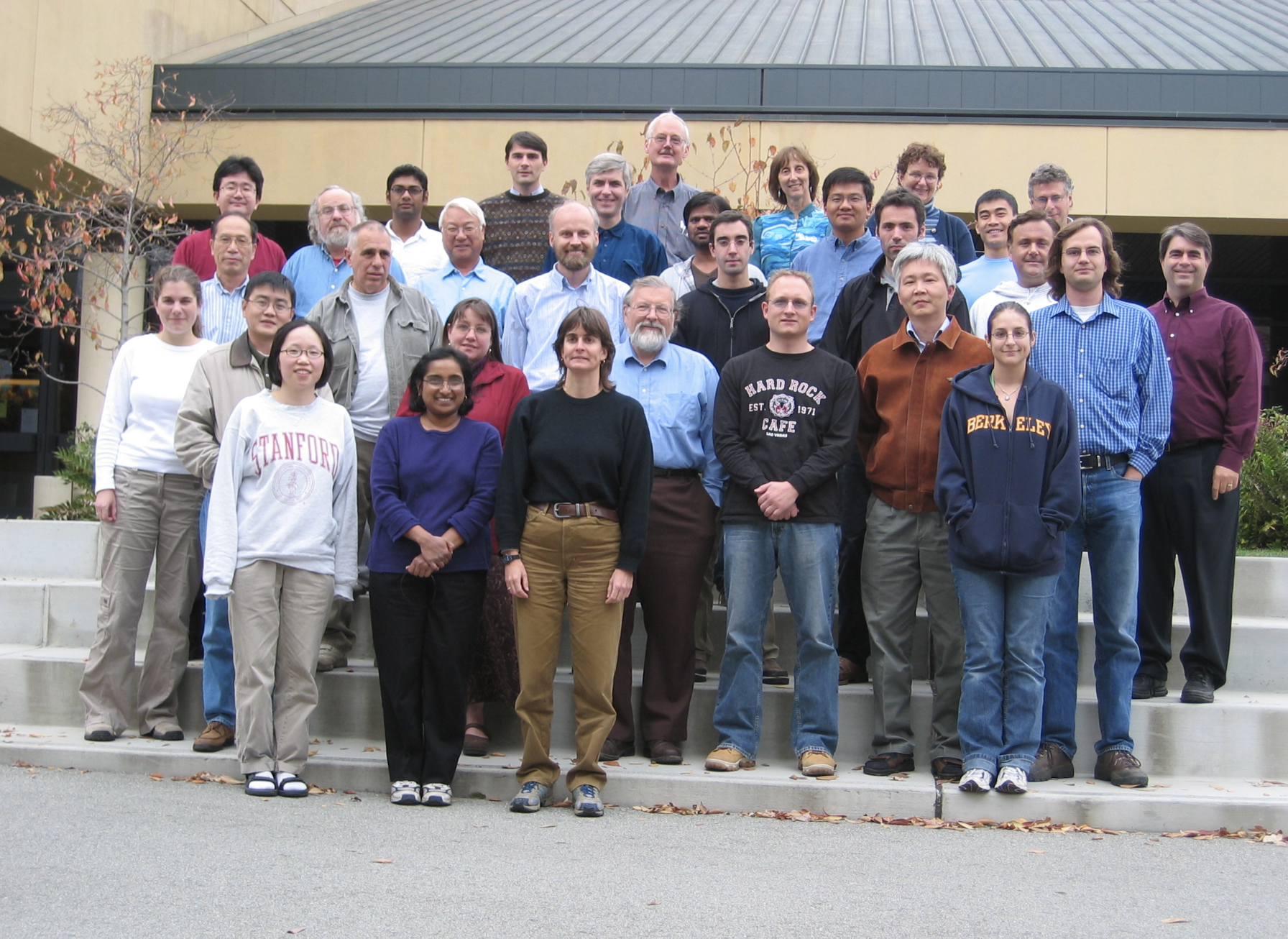
Todd and his team at Stanford, 2004.
Hoeskema’s years at Stanford have been highlighted by innumerable moments of impact and discovery. From 1989-2022 he served as Senior Research Scientist at the aforementioned Hansen Lab and became a Physics Professor in 2022. He has been Director at the Wilcox Solar Observatory since 2004. His newest appointments are at the COFFIES DRIVE Science Center, where he has served as Director since 2020, and as Principal Investigator of NASA’s Helioseismic and Magnetic Imager (HMI) instrument.
It was, you might say, in the stars.
And for Hoeksema, the work is never done. This, I assume, is the allure for any great scientist – there is always something new to discover, as long as you are willing to seek.
***
Much of his professional seeking has a dotted line to 1990 when he helped build the Michelson Doppler Imager (MDI), a seminal project that changed the way the world understands the sun.
“I became convinced that putting a telescope in space was critical,” he says. “Having access to observations of the changing sun all the time – there was no nighttime in space where MDI went! – was a true game changer, and really fun. It soon became clear that we needed even more capable instruments – and what better way could there be to help make that happen than to work at NASA?”
In 2000 Hoeksema paused his observing career at Stanford and spent four years at NASA headquarters in Washington DC creating science policy, helping to establish the Living With a Star (LWS) Program, and defining its first mission: the Solar Dynamics Observatory (SDO). According to the LWS website, the program “provides missions to improve our understanding of how and why the Sun varies, how the Earth and Solar System respond, and how the variability and response affects humanity in Space and on Earth.”
The game was on. In 2010, the work done with LWS resulted in the launch of SDO, which now provides the information needed to forecast space weather. And why is space weather important to us earthlings? Certainly Hoeksema could offer a detailed explanation in jargony, nuanced science, but that has never been his way.
“I’ve always liked explaining things,” he said in an interview for the 2018 AGU StoryCorps Archive Project. “Not only do you look really smart, but people are actually interested. It’s fun to take a complex idea and reduce it to the things that actually matter.”
Things like radio communication. And the electrical power grid. And online security. And, you know, being able to log onto Facebook.
In the 2018 interview, Hoeksema, in his thoughtful, easy-to-understand way, discussed how space weather can impact all of these things.
***
The Scientist and Serendipity. 
If a movie is ever made about Todd Hoeksema’s life, this should be the title. Many a researcher might take umbrage with this notion, the idea of happy accidents and things occuring by chance, but not Todd. Not the guy who, following undergrad, thought he’d end up a solid state physicist. Not the guy who found himself running a Stanford observatory before he even started his graduate studies. Not the guy whose curiosity about the sun led to a position with NASA.
For that guy, the divine and the empirical have always been intertwined.
“I took what seems like a fairly standard career path for a scientist,” he says. “But at every stage I benefited from communities and institutions that enabled me to take advantage of opportunities that were available, not the least of which was Prairie. While some parts of my career journey were planned, even more depended on serendipity, people, and providence.”
That’s Todd Hoeksema, the brilliant, laid back, curious, funny, quick to offer an explanation scientist, the guy with one of the coolest jobs on the planet.
