
Ready and Willing
Kayla Zeno continues tradition of teaching CPR at Prairie.
The lesson learned was this: it’s good to be prepared.
Several years ago, Kayla Zeno, Prairie’s Assistant Athletic Director for Sports Information, was idling at a four-way stop in Yorkville when two cars violently collided in the middle of an intersection. “It was one of those things I could see unfolding, but couldn’t do anything about. One car had the right away, and the other decided he was going as well.”
The result was a nasty crash. The horrible sound of metal chewing into metal. Temporary chaos. And while there was nothing any of the onlookers could have done to prevent the accident, as a certified athletic trainer with a background in healthcare – as well as a natural proclivity for pitching in – Kayla knew what to do next. Leaving her vehicle, she hurried over to check on the driver who’d been hit and immediately got to work calming him down and stabilizing his C-spine.
“EMS showed up and they were kind of surprised,” she recalls. “They were like, ‘what do you do for a living?’”
Thankfully, the driver that day never lost consciousness. Kayla didn’t have to administer CPR. But that’s not the point of this story. The point of this story is that she could have.
And that – the importance of being prepared – is what she’s working to impart on Prairie’s thirty-six eighth graders this semester.
____
This is not your typical classroom.
For one, it’s located off the beaten path, far removed from the Upper School, in the recesses of the Field House, accessible via a network of hallways that feel like tunnels.
Two, there are legless mannequin torsos and plastic baby dolls everywhere.
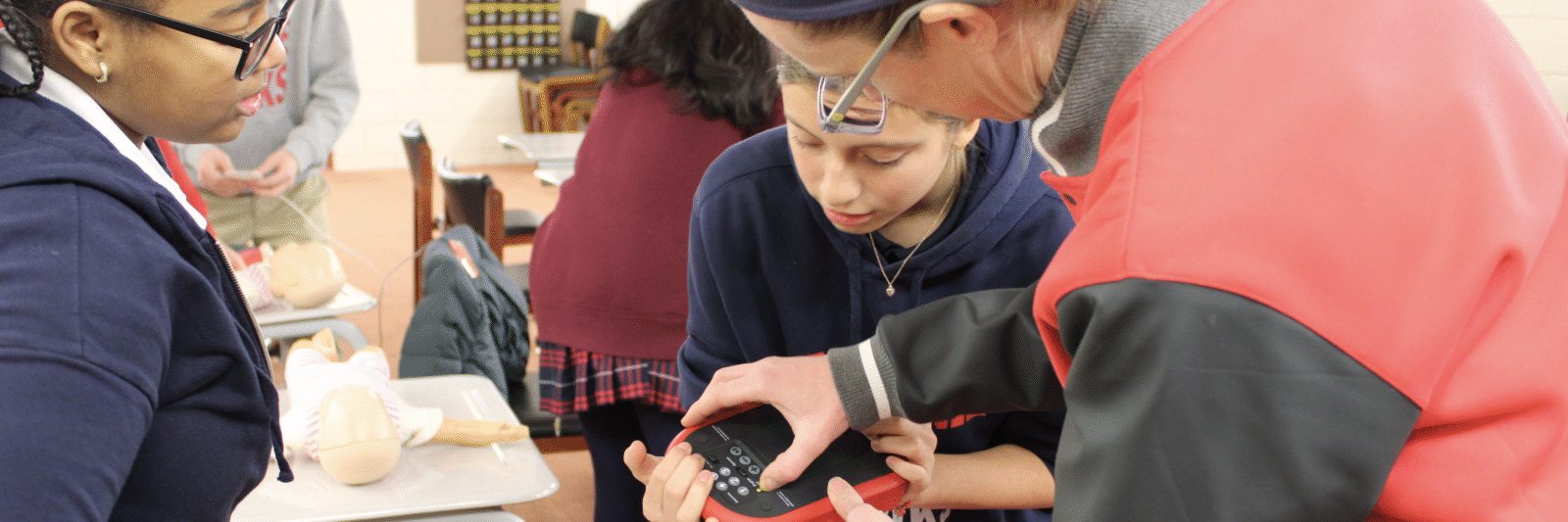
Thirdly, the half dozen fourteen-year-olds in the midst of learning the differences between adult and child chest compressions are locked in. (This is not to suggest your typical teen is not equally locked in when working with math integers or participle verbs, but there’s something about mannequin torsos and Automated External Defibrillators (AEDs) that make students sit up a little straighter.)
The CPR curriculum Kayla is using comes directly from the American Red Cross. These students – along with their classmates – have already completed an online course focused on four modules: Basic First Aid; Adult, Child, and Infant CPR; Life-Theatening Bleeding; and Choking.
From there, they are spending three FLEX periods, six eighth graders at a time, putting what they learned online into real world scenarios, practicing lifesaving skills such as clearing airways, administering breath, understanding chest compression depth, and hooking up and working the AEDs.
“You hold them a little bit like a guitar,” Kayla says, cradling a plastic baby in the nook of her arm, the doll’s head angled down. “Why?”
“In case there’s something in their mouth,” says one of the girls.
“Correct. In case there’s something in there or in case they vomit. If they vomit you don’t want them choking, you want it going to the ground.”
___
CPR has a long history at Prairie. For years, Melody Owsley, former girls’ basketball coach and physical education teacher, taught it to Upper School students as a semester-long class, the students meeting approximately every other day.
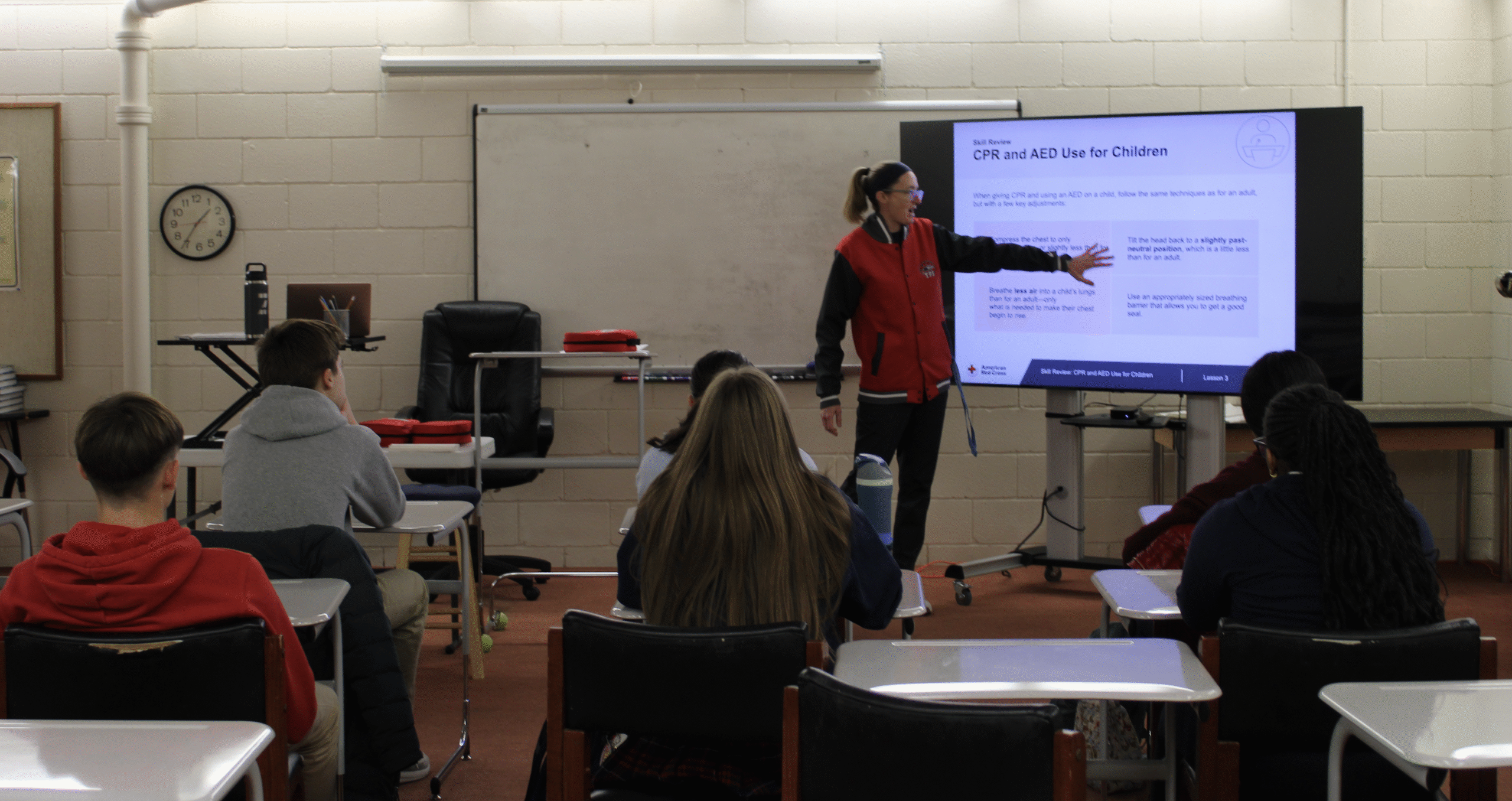 Following Owsley’s retirement last summer, Prairie was in search of a logical next step. While determining CPR didn’t need to remain as a semester-long class, school leadership still very much valued the lessons – both practical and theoretical – that CPR instruction offered students.
Enter Kayla, the former athletic trainer who has built a career on being prepared.
And pitching in.
“Continuing what Mel started seemed important,” she says. “We’re starting out this year with a pilot course for the 8th graders and we’ll see how it goes. Maybe it will stay in 8th, maybe it will move back into the high school. I don’t know. But the kids seem excited. They’re eager to get certified. A lot of them have expressed an interest in things like babysitting and they believe – probably correctly so – that this certification will make them feel more prepared for situations like that.”
According to recent statistics, 65% of American adults have ever received some kind of CPR training in their life. A 2018 Cleveland Clinic Study revealed that while 54% of Americans reported “knowing” CPR, only one in six understood the recommended techniques for bystander CPR, and even fewer – 11% – knew the correct pace for performing compressions, something Prairie’s current 8th grade class now knows is 100-120 per minute.
After the students complete their in-person training they will officially be Adult and Pediatric CPR certified for two years. Then, it is up to them to seek recertification if they so choose, something Kayla is more than willing to help with in the future.
____
This particular class ends with the six students, their thumbs extended, practicing both one-hand and two-hand chest compressions on the plastic babies. Before the compressions, students place the AED nodules on the babies’ chests. Thanks to iPads that are connected via Bluetooth to the mannequins, the students receive immediate feedback on technique.
“What method would you say is more effective, one hand or two hand?” asks one of the students.
Kayla takes a second to think. “Tough to say. I’ve always preferred the two hand. But the one-hand technique is new. It just came out in December. It’s new science. You’re some of the first to learn it.”
A caring instructor teaching new science using state of the art technology.
How’s that for being prepared?
